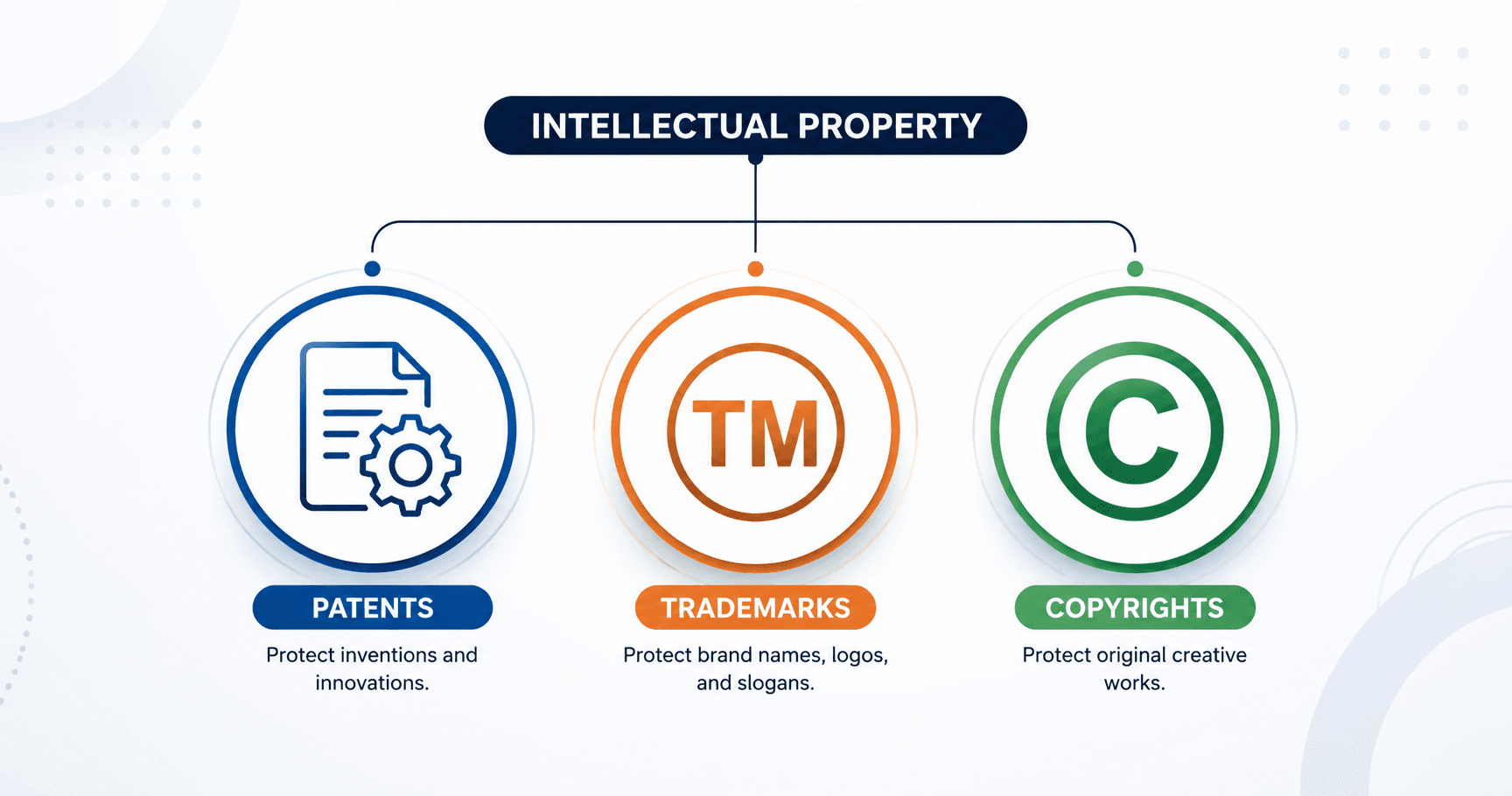
In the world of intellectual property (IP), trademarks, copyrights, and patents play crucial roles in protecting different types of assets. Understanding the differences between them is essential for businesses, entrepreneurs, and creators who want to safeguard their ideas and brand identity .
For many startups, intellectual property (IP) is their most valuable asset, sometimes even more important than equipment, inventory, or real estate. In 2026, as businesses launch online and compete globally from the start, failing to protect IP can slow growth, turn away investors, or erase your competitive edge .
This guide explains the fundamental differences between trademarks, copyrights, and patents—with real-world case examples from 2025–2026—to help you choose the right protection for your creations.
The Big Three of Intellectual Property Law
Trademark
A trademark protects brand identifiers—words, phrases, symbols, designs, or combinations—that distinguish your goods or services from others .
- Nike swoosh logo
- "Just Do It" slogan
- Coca-Cola bottle shape
How to obtain: Federal registration with USPTO (or local authority) provides nationwide protection, but common law rights arise through use (™ symbol). ® indicates federal registration .
Copyright
Copyright protects original works of authorship fixed in a tangible medium—books, music, films, software, and art .
- A novel by a bestselling author
- Taylor Swift's song lyrics
- Software code for a mobile app
How to obtain: Automatic upon creation. Registration with the U.S. Copyright Office is optional but recommended—it provides legal benefits for enforcement .
Patent
A patent protects new and non-obvious inventions and discoveries—processes, machines, articles of manufacture, compositions of matter, or improvements .
- Pharmaceutical drugs like Pfizer's COVID-19 vaccine
- Apple's touchscreen technology
- Thomas Edison's electric light bulb
How to obtain: File with USPTO. Must demonstrate usefulness, novelty, and non-obviousness .
Design Patent
A design patent protects the ornamental, non-functional appearance of an article of manufacture .
- Unique shape of a perfume bottle
- Iconic furniture designs
- Computer monitor stand appearance
Design protection focuses on the visual appearance of products. Unlike utility patents, design law does not protect functionality .
Quick Comparison: Trademark vs Copyright vs Patent
Real-World Cases: How Courts Draw the Lines
"Bad Spaniels" dog toy mimicking Jack Daniel's bottle.
Warhol's Prince Series based on Goldsmith's photograph.
Enablement of antibody claims.
3D trademark for gummy bear shape.
The Gummy Bear Lesson: Rights Overlap, But Stay Distinct
Media coverage confused "copyright" and "patent," but the case was purely about trademark law. The ruling emphasizes that different IP rights protect different features and work in different ways .
When Rights Collide: Trademark vs Copyright vs Design Patent
In practice, IP rights often overlap—and sometimes conflict. Courts apply consistent principles to resolve disputes.
The "Peppa Pig" character—protected by copyright—was registered as a trademark by unauthorized parties. The Shanghai Intellectual Property Court followed the "protection of prior rights" principle, ruling that the trademark infringed on the copyright owner's prior rights .
French company's "hand-holding-axe" graphic trademark conflicted with a later design patent for a liquor box. CNIPA declared the patent invalid, finding it conflicted with the prior trademark .
A design patent for a "Talking Tom" toy was invalidated because it copied the copyright-protected character design created years earlier .
Court's framework for resolving IP conflicts:
- Right of prior creation is protected
- Burden of proof on the party claiming prior rights
- "Substantial similarity" test—overall observation plus feature comparison
- Rights cannot be overbroadly expanded into public domain
U.S. Supreme Court Clarifies the 'Big Three'
Trademark — Rogers test does not apply when mark used as source identifier.
Copyright — First fair use factor weighs against commercial use sharing same purpose.
Patent — Enablement requires specification to cover full scope of claims.
Common IP Mistakes New Businesses Make
- Waiting too long to register trademarks—brand disputes arise after marketing begins
- Assuming business formation protects brand names (it does not)
- Skipping IP assignment agreements with founders, employees, and contractors
- Using AI-generated content without understanding ownership risks
- Disclosing inventions before patent review—public disclosure can destroy patent rights
- Assuming copyright covers functionality (it does not—design patents or utility patents required)
IP Strategy Checklist for 2026
Clearance Search
Before committing to a name or logo, search existing trademarks, industry usage, and online conflicts .
IP Assignments
Ensure founders, employees, and contractors sign agreements assigning IP rights to the company .
Register Trademarks
File with USPTO or local authorities for brand protection. Consider key foreign markets if selling globally.
Copyright Registration
Register core works (software, content, designs) to strengthen enforcement rights.
Patent Review
Assess inventions early; file before public disclosure. Design patents for product appearances.
AI Governance
Address ownership of AI-generated content in policies and contracts—current law remains unsettled .
International Protection
Consider trademark and patent filings in key markets—U.S. protection doesn't cover you abroad.
Periodic Audits
Review IP portfolio annually; identify gaps, update registrations, and enforce against infringers.
When to Consult an IP Attorney
You should consult legal counsel when :
- Choosing a business or product name
- Developing proprietary technology
- Hiring contractors or developers
- Using AI tools for core content or code
- Preparing for funding or acquisition
- Expanding to new markets
- Discovering potential infringement
Intellectual property law involves nuanced interpretation. Professional guidance helps align legal protection with commercial goals. Errors in early filing often prove irreversible.
Choose the Right Tool for the Right Asset
A Framework for Copyright, Trademark, Patent, or Design begins with understanding the nature of what is being protected. Intellectual property law does not apply a single solution to all creations. Instead, protection depends on whether the subject matter involves creativity, branding, technical innovation, or visual appearance .
- Trademarks protect brand identity—choose these for names, logos, slogans, and source identifiers.
- Copyrights protect original expression—choose these for content, software, art, and creative works.
- Patents protect inventions—choose these for new, useful, non-obvious processes, machines, or compositions.
- Design patents protect visual appearance—choose these for product shapes and ornamentation.
Some creations qualify for more than one form of protection. Each right serves a different legal function. Strategic use of combined protection strengthens overall coverage .
In 2026, intellectual property is often at the heart of a new business's value. Your brand, technology, and creative work deserve as much attention as funding and product development .