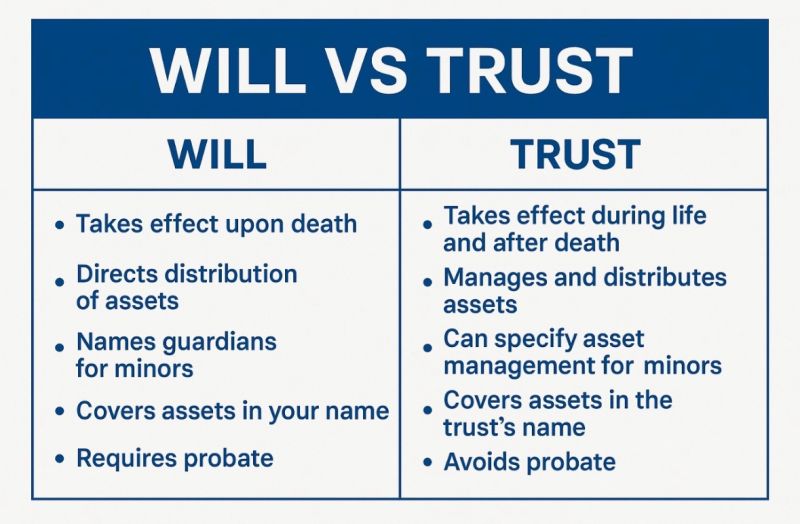
One of the most important decisions in estate planning is whether you need a will, a trust, or both. Wills and trusts can help you shape an estate plan to fit your needs. Knowing the differences between them can help you decide whether you need just one or both .
Understanding how they compare can help you make informed decisions about your family's financial future. This guide breaks down the legal jargon into plain English and provides practical guidance for 2026 .
Will vs Trust: Side‑by‑Side Comparison
Last Will & Testament
A will is a legal document that specifies how your assets should be distributed after your death. It only takes effect upon your death and must go through probate court .
Revocable Living Trust
A trust is a legal arrangement where you transfer ownership of your assets to a separate legal entity managed by a trustee. Trusts can be active during your lifetime .
2026 Federal Estate Tax: $15 Million Exemption
For 2026 and 2027, the federal estate tax exemption is:
per individual — $30 million for married couples
However, you may be able to remove assets from your taxable estate using an irrevocable trust. If that's a strategy you're interested in, consult an estate planning attorney who specializes in irrevocable trusts and estate tax management .
2026 Probate Fee Changes: What You Need to Know
Flat rate for estates > £5,000 (up from £273)
Increased 967% from £1.50
CS/HB 759 would increase probate filing fees
Probate filing fee
The most dramatic change is the UK's 967% increase in official copy fees. Many estates require several official copies because financial institutions insist on seeing sealed originals before releasing funds. Ten copies that once cost £15 now cost £160 .
The Pour‑Over Will: Bridging the Gap
If you have a living trust, you still need a will—specifically, a pour‑over will. This specialized type of will works in tandem with a living trust and has become an increasingly essential component of modern estate planning .
Advantages of a pour‑over will :
- Ensures all assets are correctly accounted for
- Asset automatically transferred to intended beneficiaries according to trust terms
- Provides additional protection against creditors
Disadvantage: A pour‑over will must go through probate before the property passes through. This could lead to significant delays—if the living trust has valuable assets that need to be distributed, they may remain stuck in probate until months after your death .
The Groucho Marx Lesson: Why Funding Matters
A primary benefit of the living trust is that it avoids a conservatorship. If you have only a will, own substantial assets and become unable to manage your property, it may be necessary to conduct an expensive and lengthy court process to appoint a conservator of your assets .
Funding Your Trust: The Critical Step Most People Miss
To be valid, a living trust must be "funded." It is not sufficient to create and sign a trust document. You also need to take action to ensure that the property in question is actually held by the trust .
Transfer via warranty deed or grant deed (depending on state). Deed must be notarized and recorded at the county registrar .
Transfer directly to trust; create a trust securities account .
Can be taken out in name of trust; some institutions require certified copy of trust on file .
Many choose to retain personal ownership to simplify transfers. If valuable, can be transferred .
Do NOT transfer IRAs, 401(k)s to living trust (taxable event). Instead, name trust as contingent beneficiary .
Which Is Right for You?
- You have a small, straightforward estate
- You have minor children (to name guardians)
- Your state has simplified probate procedures
- You want the simplest, most affordable option
- You own real estate, especially in multiple states
- Privacy matters to you (avoid public record)
- You want assets distributed quickly (weeks vs years)
- You have a blended family or complex dynamics
- Your state has expensive/time‑consuming probate
- You want to establish conditions for inheritance
For many people, the right approach combines both documents: a revocable living trust for major assets (especially real estate and investment accounts) and a pour‑over will to catch anything not transferred to the trust and to name guardians for minor children .
Other Trust Structures to Consider
Key Estate Planning Terms
Testator
The person who creates and signs a will .
Executor
Person appointed in will to carry out final wishes .
Trustee
Person responsible for managing assets held in trust .
Grantor / Settlor
The person who creates and funds a trust .
Beneficiary
Person or organization designated to receive assets .
Probate
Legal process of validating a will and distributing assets under court supervision .
Your 2026 Estate Planning Action Steps
Create an inventory of all assets—real estate, investments, retirement accounts, digital assets. Note how each is titled and whether beneficiaries are named.
Research your state's probate fees and procedures. If you live in a state with expensive probate (like California or Florida), a trust may be more cost‑effective.
Blended families, minor children, or special needs beneficiaries often require trust structures to ensure assets are protected and distributed as intended.
Work with an estate planning attorney and financial professional. They can help structure your plan, fund trusts properly, and coordinate with tax advisors.
Sign your will (with proper witnesses/notarization) and trust documents. Then—crucially—fund the trust by retitling assets.
Update your plan after major life events (marriage, divorce, births, deaths) and every 3–5 years to ensure alignment with changing laws.
Both Tools Have Their Place
When comparing a trust vs. a will, remember that one isn't necessarily meant to replace the other. Both a will and a trust can help you to manage your estate assets in different ways .
- Wills: Essential for naming guardians, simple estates, and serving as a safety net with a pour‑over will. Must go through probate.
- Trusts: Provide privacy, probate avoidance, asset management during incapacity, and control over distributions. Require funding to work.
- Pour‑over wills: Bridge the gap—catch any assets not transferred to the trust and direct them into the trust upon death.
The choice between a will and a trust depends on your assets, family situation, and goals. For many people, the right answer is both. With proper planning, you can ensure your assets accomplish what you intend — for your spouse, your children, your grandchildren and the causes you care about.
As one experienced attorney notes: "Living trusts can help you avoid probate, but can be tricky to fund, that's why a pour‑over will is a good safety device to protect intended beneficiaries" .